 by
by Hybrid Funds invest in a mix of asset classes. Most Hybrid Funds invest in equity and debt although there are funds that have more asset classes like gold, international equities, etc. in their portfolio.
- Hybrid funds allow you to have a diversified portfolio with just one fund
- Invest in them for goals you want to achieve in 3 to 5 years
- Multi-Asset hybrid funds give you exposure to at least 3 asset classes together
4.4
Avg. app ratings1 Cr+ downloads
77,000Cr+
InvestmentManaged
1,100Cr+
Monthly MFinvestment
Types of Hybrid Funds
Medium to long term
 Aggressive HybridMax up to 75% in stocks
 Balanced HybridMax up to 50% in stocks
 Equity SavingsMax up to 35% in Debt Securities
 Dynamic Asset AllocationAdjusts the allocation in various asset classes due to market conditions to provide superior returns
 Multi Asset AllocationInvests across multiple asset classes ranging from equity & debt to others
 Retirement SolutionsUses asset allocation to build retirement corpus
Funds to park money
 Conservative HybridMax up to 35% in stocks
 ArbitrageCapitalizes on ineffecient markets
Best Performing Hybrid Mutual Funds
| Scheme Name | Expense Ratio | 3Y Return (Annualized) | ||
|---|---|---|---|---|
 | Quant Multi Asset Allocation FundETM Rank: App exclusive  | 1.84% | 21.98% p.a. | Invest |
 | ICICI Prudential Retirement Fund – Hybrid Aggressive PlanETM Rank: App exclusive | 2.15% | 21.33% p.a. | Invest |
 | Nippon India Multi Asset Allocation FundETM Rank: App exclusive | 1.4% | 20.96% p.a. | Invest |
| Nippon India Multi – Asset Omni FoFETM Rank: App exclusive | 1.1% | 20.52% p.a. | Invest |
 | UTI Multi Asset Allocation FundETM Rank: App exclusive | 1.72% | 20.29% p.a. | Invest |
 | Aditya Birla Sun Life Multi – Asset Passive FoFETM Rank: App exclusive | 0.61% | 19.67% p.a. | Invest |
| ICICI Prudential Multi Asset FundETM Rank: App exclusive | 1.36% | 19.65% p.a. | Invest |
| Aditya Birla Sun Life Multi-Asset Omni FoFETM Rank: App exclusive | 1.2% | 19.54% p.a. | Invest |
 | Kotak Multi Asset Omni FoFETM Rank: App exclusive | 1.07% | 19.38% p.a. | Invest |
| ICICI Prudential Equity & Debt FundETM Rank: App exclusive | 1.53% | 19.36% p.a. | Invest |
All about Hybrid Mutual Funds
4.4
Avg. app ratings1 Cr+ downloads
77,000Cr+
InvestmentManaged
1,100Cr+
Monthly MFinvestment
How Hybrid Fund Works?
- Hybrid funds predominantly invest in two asset classes, equity, and debt. Equity as an asset class has the potential for generating good returns and creating wealth, but at the same time, it carries higher risk in terms of volatility in the short term. On the other hand, debt as an asset class includes interest-bearing instruments that generate regular income. Debt is a lower-risk asset class compared to equity. Equity and Debt Asset classes have low correlation, and hence, combining them reduces the portfolio risk.
- A hybrid mutual fund essentially tries to offer the best of both asset classes in a single product. Their Equity portion generates returns when the equity markets are doing well, and the Debt portion provides a cushion for the times that the market is underperforming. It aims to offer long-term capital appreciation through equity and short-term stability and regular income through debt. Based on the objective of the fund and the market outlook, the fund manager maintains the appropriate asset allocation at all times.
Who Should Invest in Hybrid Funds?
Hybrid funds are very versatile and good investment options for both new and seasoned investors.
- First Time Mutual Fund Investors: Investors who are new to investing are used to the stability provided by traditional fixed income instruments like fixed deposits. They understand the growth-generating capacity of the equity asset class, but fear the risk of volatility over the short term. Hybrid mutual funds offer an entry into the equity market, and based on their risk profile, they can pick a subtype with the equity exposure that they are comfortable with.
- Investors with a 3-5 year investment horizon: Investors looking to invest for a medium-term goal, like buying a car, need growth but with reduced volatility. Hybrid funds provide a good option for this category of investors. That’s because a part of the investment is in debt, the returns generated are relatively less volatile.
- Retired Individuals: This category of investors is looking for a regular income to replace their salaries or income that they made in the working years. Conservative hybrid funds with their unique asset allocation provide a regular income through the debt component and aim at generating a little more through their exposure in equity, which will help them tide them over the inflation through the retirement period.
- Investors looking for asset allocation: These investors want a portfolio with a certain asset allocation but do not have time or expertise to track the markets and manage their asset allocation. Hybrid funds are an excellent option for ready-made investment portfolios.
- Short-term investors: Arbitrage funds provide a good, tax-efficient option for investors who are looking to park money in volatile market conditions over a minimum 6-month time frame.
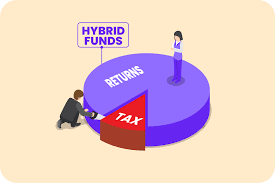
Tax Implications on Hybrid Funds
The taxation of hybrid mutual funds depends on their asset allocation. A hybrid fund that invests at least 65% of its AUM in equity or equity-oriented securities is classified as an equity-oriented hybrid fund and is taxed like an equity fund. Funds such as arbitrage funds, equity savings funds, and aggressive hybrid funds fall under this category.
On the other hand, hybrid schemes that primarily invest in debt instruments are classified as debt-oriented hybrid funds and are taxed accordingly.
- Taxation of Equity-Oriented Hybrid Funds
- Long-Term Capital Gains (LTCG): If funds are sold after holding for more than a year, they will attract long-term capital gains tax of 12.5%. Gains of up to ₹1.25 Lakh in a financial year are tax-free.
- Short-Term Capital Gains (STCG): If schemes are held for less than a year, gains are treated as short-term capital gains and are taxed at 20%.
- Taxation of Debt-Oriented Hybrid Funds
- For investments made on or after April 1, 2023: The Gains are irrespective of the holding period, are taxed as per the investor’s income tax slab rate.
- For investments made before April 1, 2023: If an investment is sold before July 23, 2024, Long-Term Capital Gains (LTCG), if held for more than 36 months, are taxed at 20% with indexation, while Short-Term Capital Gains (STCG), if held for less than 36 months, are taxed according to the income tax slab rate. If the investment is sold on or after July 23, 2024, LTCG, if held for more than 24 months, is taxed at 12.5%, and STCG will continue to be taxed at the applicable income tax slab rate.
Taxation
Debt funds acquired on or after April 1, 2023, are taxed as per your income slab rate, regardless of the holding period.
For investments made before April 1, 2023:
- Sold before July 23, 2024, LTCG (if held for more than 36 months) is taxed at 20% with indexation, while STCG is taxed at the slab rate.
- If sold on or after July 23, 2024, LTCG (if held for more than 24 months) is taxed at 12.50%, and STCG is taxed at the slab rate.